
Why Your Home Feels Overwhelming After You've Decluttered

It's very possible you've gotten organized …
Either for the first time or the most recent time.
And it's also possible that, even with the following achievements, something feels unsettled.
Let's say (or imagine) that you finally matched every Tupperware lid to its container and recycled the orphans.
You untangled the USB cables from all the other cords and got them into their own ziplock bag instead of leaving them in the bottom of a drawer.
You found a permanent home for the bag of bags—no more running around looking for a tote when you need one.
And now you're standing in your kitchen, tense, because you don't believe it can actually stay this way.
This is what it feels like to be trapped in a cycle of yo-yo organizing.
It's like finding yourself at the top of a ferris wheel, suspended, enjoying the view but knowing you're about to start heading back down to earth.
Or more thrilling and also more scary, the last few clacks as the roller coaster climbs that terrifying hill because you know your stomach will soon be in your throat as you go hurtling towards the ground.
Either way, there's that unsettling feeling of suspension while you're waiting for it all to fall apart again.
And here's the part that none of the other organizing experts or minimalists seem to want to address.
As unsettling as the chaos was, it was familiar.
Your nervous system learned to expect the stimulation.
The visual noise of stuff piled everywhere creates a low steady hum of energy.
And that is the literal and figurative sound of friction.
That hum chugs along underneath your day, all day, every day.
It's the soundtrack to any life where harmony is fractured.
Where things are never or usually not where they belong.
And it's so constant that most of us don't even hear it anymore.
It's like the buzz you sometimes hear from an overhead power line.
Or you could think of it as the tinnitus of stuff.
Which I've had since I lost my hearing at a Yes concert in 1977.
I sure thought it was cool then.
Not so much now.
So when it finally goes quiet, quiet feels wrong.
It's not peaceful.
It's the opposite of peaceful.
It's actually screaming at you ... very softly.
And that puts your nervous system on high alert.
You try to consciously relax but your subconscious is expecting a disaster.
So it's scanning the horizon, very suspicious at the absence of visible clutter.
Like the calm is a setup for something worse.
And that's what fires up the fear ... or fears.
Who's going to maintain this now that it actually looks like this?
Can I trust myself to keep it this way?
I've let myself (and possibly others) so many times before, why would this time be any different?
You know the joke—this is why we can't have nice things.
It's sort of funny.
But mostly not.
It's flip, it's fatalistic, and just because it's partly true—you've probably relapsed before, more than once—doesn't mean it's always true.
It's very possible that, as a result of the clutter and disorganization, you've broken things or lost or misplaced things that were expensive.
But like I said, partly true isn't the same as always true or permanently true.
So trying to sort through all this quiet emotional noise, it's logical to start wondering if maybe something's fundamentally wrong with you.
It's not.
The only thing that's wrong is that nobody ever taught you how to make quiet and calm the new normal instead of the exception.
Right now the road you're on is basically a string of potholes with the occasional smooth stretch you don't trust.
That's ultimately backwards from the way it's supposed to be.
Smooth is supposed to be the road.
Potholes are supposed to be the occasional exception.
The good news?
The part of you that isn't frightened and immobile can totally learn this.
First, let's start with the recipe for getting organizing and decluttering:
- Decide what actually matters to you first
- Then sort like with like
- Then decide what stays and what goes
- Then give everything that's staying its one home
- Then containerize it—only once you know what you're actually housing
- Then you release the stuff you're finished with
Pretty simple and straightforward, right?
Now, here's the last bit that nobody seems to want to teach you: how to maintain it.
The online gurus love to feed you clickbait about what's wrong (with you) and then offer up listicles of quick fixes.
That keeps that hum chugging along, too.
Or they tell you to either accept clutter as a part of life or that the only way to not be ruled by stuff is to get rid of most of it.
That creates its own feedback loop.
But the strongest, most sustainable solution is so much simpler than that.
Here's the recipe for staying organized:
- Put things back where they came from
That's the maintenance piece, right there.
The entire mystery solved.
Put the thing back, whatever it is that you took out, every time—the same way you now brush your teeth.
You don't have to think about it.
You don't need to schedule it or fret over it.
You walk into the bathroom, pick up the brush and go.
Same thing here.
So, now, instead of setting it down on a surface and telling yourself you'll put it back "later," you put it away in the moment.
If you start doing that, you don't have things piling up.
Now, the part of you that's feeling beaten up is most likely also the part of you that's been burned before.
It's more than a bit tired, definitely skeptical, and just like Charlie Brown with the football, half-daring to hope that this advice or attempt will be different.
And also secretly terrified that nothing can solve this problem.
So, here's a bit more truth: this time can be different if you follow the recipe.
Stop trying to hack the recipe, stop trying to shortcut the recipe… just follow the recipe.
And know this going in—organizing and tidying up deals with the stuff you can see.
The surface stuff.
Which is certainly real, and matters.
But it was never going to be the whole answer.
Because looking calm and feeling calm are not the same thing.
Back to the hum.
I call surface organizing the illusion of order.
Because most organizers, even the ones with Netflix shows, are obsessed with how things look and where they go.
What containers they live in.
What the labels look like.
And sure, all of those products and supplies can absolutely make a space look better.
But just like playing house in kindergarten, only now you're doing it on a much larger scale, eventually it's time to stop playing at something and actually do the work.
Because pretty containers and fancy labels will never provide the foundation you need for your home to be sustainably functional.
And for that hum to slowly go away.
Surface organizing can't give you what you need so you don't feel held hostage by either a clean or a messy space.
And if you've been around here for a while, you probably know that clutter isn't only about the physical stuff, right?
It's about everything other than the stuff that hasn't been resolved yet.
That's what I call the 'stuff behind the stuff.'
And there are three things that are quietly running the stuff behind the stuff show, regardless of how clean the surface looks.
UNMADE DECISIONS
The first culprit is unmade decisions.
Every item you haven't decided about is still active in your brain.
Remember the hum?
It might be out of sight, but it isn't out of mind.
It hasn't been forgotten.
Your desperate lizard brain is tracking everything in its attempt to feel safe.
Which reminds me of one of Unstuff Your Life System® graduates, Marianne Wayland.
Her husband watched her work through her own stuff using the system, and it changed how he saw his garage—and not because she was constantly nagging him.
Because watching her work, he finally understood that the garage wasn't messy from a storage problem.
It had become a mess because of several dozen decisions he'd stopped making or never made.
So when you look around your own space, what do you see?
Maybe it's that shoe box on your closet shelf—is it empty?
Is it full and the shoes inside don't fit or are ready to be retired?
Are you not sure, can't commit, or can't decide?
Do you need to try them on one more time before you choose?
What about the stuff shoved into a drawer in your desk.
Old pens and other office supplies that you don't use but are still "good."
What's the plan for them?
Just let them hang out until "later?"
Or "someday?"
And if you were thinking the solution is just getting a bigger or "better" tray insert for the drawer…
Let's be clear: organizing products don't resolve unmade decisions.
They just make the Container Store a lot of money.
And they dress up your clutter really pretty.
Peace doesn't come from owning less stuff, or I should say, is not dependent on owning less stuff.
You don't need to be a minimalist to have a peaceful home—if keeping score makes you more anxious than just having stuff.
Peace comes from having enough of everything that serves you and nothing that doesn't.
And from decisions that are actually complete and not lingering.
If less stuff feels good, go for it.
And if you don't really want to waste time constantly pruning your belongings, just make the decisions once and move on.
That's the way to lasting peace in your own home.
EMOTIONAL DEBT
The second culprit is emotional debt.
Some objects don't just take up space.
They take up energy.
The sweater from your ex you keep telling yourself you're sure you'll wear more often, but every time you put it on, you get a little sad… or angry… or regretful.
That book your friend gave you that you think you should read but you don't want to.
And every time you see it sitting on a shelf in the closet you feel guilty and like you're letting your friend down.
Or that decorative bowl your in-laws gave you that you think is hideous but you don't want to hurt their feelings so you hold onto it.
You don't use it but just having it tucked up in the cabinet over the fridge makes you feel less like a jerk and more like yourself.
At least that's what you tell yourself any time you open the door and see it sitting there.
Every one of these things, and things like them, drain your energy.
And it's hard enough to get through the day feeling great, right?
Imagine how much harder it is to get through the day dragged down by all the regret, shame, blame and guilt you feel walking past things you wish you didn't see but aren't willing to let go of… yet.
The first round of decluttering won't fix that.
Nor will fancy labels or clear acrylic containers.
Because these kinds of issues can't be solved by hiding an object or avoiding an object or parking it 5 miles from home and paying to store it every month.
That emotional debt isn't object-centric—it's not really about the objects themselves.
That debt is the cost of holding onto every one of those objects as a reflex instead of a deliberate choice.
That's the source of the hum and that is exactly the stuff behind the stuff.
MISSING OR FAULTY DECISION SYSTEMS
The third, and in some ways the simplest culprit to address, is either a non-existent or a broken decision-making system.
Most of us were never taught how to make important decisions.
And by important, I mean significant.
They don't have to be life or death decisions but they are usually tied to our values and our life's meaning.
Sure, most of us can pick a flavor of ice cream in about two seconds.
But how often have you stared at a menu trying to decide between what you want to eat and what you think you should eat?
Or whether you should pay for the upgrade or get the travel insurance or what limit you should set your deductible for your car's comprehensive coverage?
Big questions that come with consequences are a different story.
So instead of deciding, you shop.
Maybe to distract yourself you shop for new things.
Or you tell yourself that shopping is just research with tangible results.
That is definitely one of your 200 lies.
And that story goes like this.
If you can just find the right container or the right system, you won't have to make any other decisions.
So, you search and you search and you scan.
And in the meantime, you stack and you pile and then you sift and arrange and then you rearrange again.
Then you relocate and repackage and then you sort one more time and then, when you're finally exhausted from moving stuff around over and over, you surrender and dump everything into the largest tub you can find.
None of that behavior, as busy as it might keep you, affects any of the decisions you've already deferred, let alone the new ones showing up every day.
Sylvia Pettigrew changed her entire life in seven-minute sessions—not because seven minutes is the magic number, but because seven minutes kept her focused.
That way she could meet the day's decisions with precision and some speed because she knew the clock was ticking.
Cheryl worked her way through her childhood home deciding what she'd bring to her home based on five things.
Was the item she grew up with:
- Better functioning than the one she had at home
- More attractive than the one she had at home
- More valuable than the one she had at home
- More meaningful than the one she had at home
- Something she didn't already have at home but had an actual need for
If it didn't meet any of those criteria, she could make her peace with the item leaving her life knowing that while it may have been around during her childhood, it wasn't her childhood.
Boundaries, whether they're time-specific, quality-specific or quantity-specific, help make decisions frictionless.
Without them, every organizing attempt wears you out.
Every choice feels isolated and loaded at the same time.
And because stuff keeps coming in in lots of forms, without a system some of that stuff will inevitably become clutter.
Here's a fact that might make you mad.
A lot of professionals in this field run into similar challenges.
Back to the ice cream analogy, some of them are only equipped enough to help you decide easy things.
Should we toss this old Pottery Barn catalog from 2013?
Can we let go of these dried out pens and expired AA batteries?
These food storage containers that don't have lids—is it ok to get rid of them?
And they can help you dress up the outsides by putting things in pretty boxes and tubs.
One private client had worked with another organizer before she hired me and they had insisted that she buy some expensive opaque cardboard boxes with handles for her to store things in.
These boxes couldn't be stacked easily without being crushed—they were made out of flimsy materials.
They were bright red and blue so they were colorful, but you couldn't see what was inside them.
The colors didn't seem to coordinate in any way with the contents—they were just not all the same color.
I guess variety is the spice of life.
They didn't have a place for a label so again, you'd have no idea what was inside them.
These organizers were either not skilled enough or interested enough to help with the root causes for why the stuff was there in the first place.
For sure, surface fixes are easier to deliver.
And maybe they're people pleasers and were afraid that any directness would be confused with being confrontational.
Whatever the reason, the problem remained that they never got to the stuff behind the stuff.
So my client had a bunch of boxes with a bunch of stuff in them and no clarity on what to do with the stuff or why the stuff was there in the first place.
Remember, I never tell any clients what to keep and what to let go of—that's their decision.
I'm there to support them in making the strongest choices for themselves.
But here's what I do know:
Surface-based solutions don't last.
In fact, they can't last without somebody always there to maintain them.
And if those surface choices don't match who you actually are or how you actually live, their life expectancy will often be days, if not weeks.
That's why all the work and coaching I do teaches you how to build and maintain the decision-making process or system inside you.
Because if you can't learn to trust your own judgment, you'll always be dependent on someone else to reset your space for you.
That's not freedom.
That's co-dependence with a fancy paint job.
THE BOTTOM LINE
Learning or discovering this doesn't mean you have to start over.
It just means that the next round of activity probably shouldn't be focused on simply attacking more stuff.
You'd be better served building the confidence and competence needed so you can clear the backlog of decisions you've been dragging around behind you.
And designing how you decide in the first place.
A recent visitor to YouTube posted that they didn't want to spend time sorting like with like first—they wanted to get rid of stuff first.
And for low hanging fruit, that's great.
But if you don't know what your low hanging fruit is, then the simplest way to decide is to bring all like objects together and decide what stays after.
It's right there in the recipe.
One-off decisions made in isolation burn through so much more energy and create friction and can feel nearly impossible—they're so tangled up in story and memory.
But when you line your sweaters up side by side, or every extra tote bag next to every other extra tote bag, the story is no longer the strongest factor in your decision.
Your choices are based on function and condition first, not about who gave it to you or who you used to be.
So—is it your stuff that's the real problem, or is it every decision you've been putting off about that stuff?
If you're honest with yourself, it won't take you long to figure out which one it is.
And once you do that, quiet won't be so scary any longer.
Now, if all you needed was to read this article and you're ready to do this on your own, start with my book Unstuff Your Life!
It walks you through the same decision-first approach I just outlined above.
And that's the same process I use with all my private clients so you can move at your own pace.
If you know that your pace means you'll get around to it someday...
Or that you'd rather move faster, with support, and actually finish the backlog instead of managing it forever, that's exactly why I built the De-Stress Your Mess Challenge™.
5 days, real decisions, real momentum.
Join here → https://go.andrewmellen.com/dym
And if what trips you up most is the actual moment of deciding—keep, sell, or donate—the Declutter Decider app was built for exactly that.
It walks you through the same decision logic I've used with clients for 30-plus years while harvesting the best of AI to speed up the process.
Give it a try here → https://declutterdecider.com
Remember, it all starts with a timer and one decision.
Start there.
Conquer Your Clutter in Just 5 Days!
In 5 days, with ZERO overwhelm, you can tame your clutter with my simple, easy-to-use system.
Unlike those other quick-fix bandaids, THIS system solves the root cause of clutter—so it's gone for good.
For details about the next challenge, click the button below.
Video replays available 24/7 ... so you'll never miss a thing!
.png)


How Does Clutter Affect Your Mental Health?
Clutter affects your mental health because every decision you've postponed keeps running in the background. Here's how to start closing those open tabs—15 minutes at a time.
Read the article →
How to Organize Your Closet Without Buying Anything (Even When Swapping Seasons)
The seasonal closet swap moves the same undecided clothes back and forth twice a year. Here's how to turn it into a checkpoint and stop paying the swap tax.
Read the article →
Where to Start When You're Downsizing (Whether You Chose It or Not)
Downsizing isn't a bigger decluttering project — it's a decision problem with a clock attached. Here's how to prioritize so you don't waste time on the wrong things.
Read the article →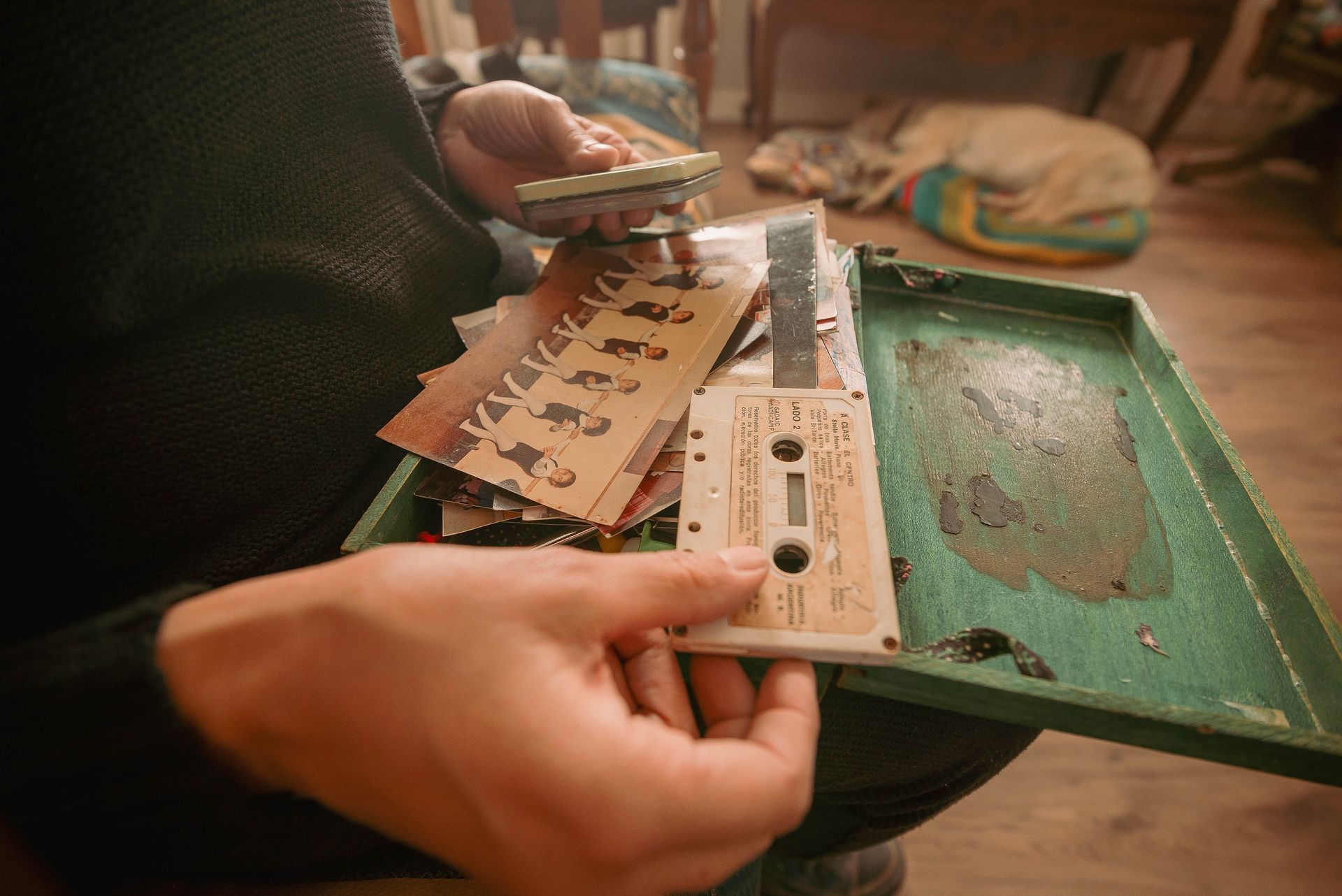
How to Let Go of Sentimental Items (Without the Guilt)
Letting go of sentimental items isn't about being ruthless — it's about separating the memory from the object. Here's the actual reframe that makes it possible
Read the article →
How to Organize Paper Clutter (Before It Takes Over Your Life)
The pile isn't a filing problem — it's a decision problem. Here's why paper clutter is so hard to face, and the actual system that ends it for good.
Read the article →Why Your Home Feels Overwhelming After You've Decluttered
You organized everything and it still doesn't feel calm. Here's what's actually running the show behind the clutter — and how to fix it for good.
Read the article →