
How to Stop Overcommitting During the Holidays (and Say No Without Guilt)
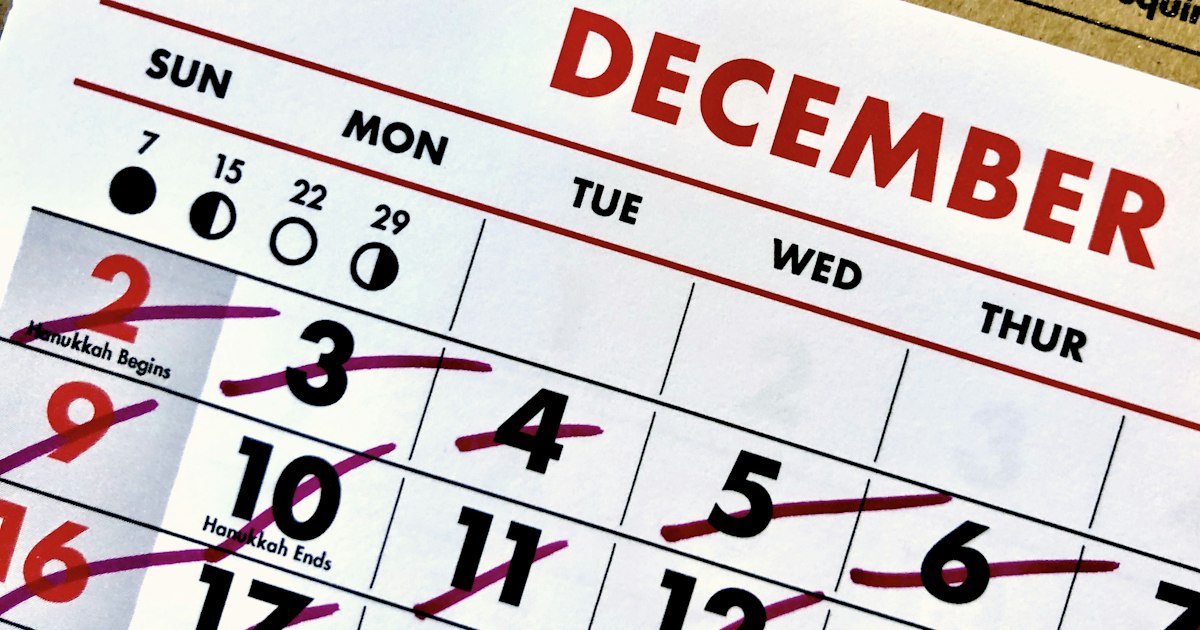
Did you just say yes to something related to the holidays—again—because you're expected to?
Even though you don't want to, or don't really have time for it?
When it comes to overcommitting, it doesn't really matter what you overcommit to—you experience the stress the exact same way.
So, “offering” to bake six dozen cookies for the school cookie exchange, or RSVPing to the third holiday party in one week, or agreeing to a 2-hour round trip airport run lands in the exact same way.
And now you're looking at the end of the year as another marathon you have to survive just to get a break between Christmas and New Year's if you're lucky.
So how do you stop overcommitting during the holidays without freaking out, alienating people you genuinely care about or leaving town?
If you're reading this after already making some unwanted commitments, I'll give you some tips on graciously bowing out without pissing everybody off.
And if you haven't said yes yet, I'll show you exactly how to say no without that acid swirl in your stomach bubbling up into your throat.
Either way, you're up against the same thief.
Overcommitting is one of the 8 Deadly Time Thieves I write about in Calling BS on Busy, and I wrote about how to stop overcommitting and still get what you want back in 2023.
Overcommitting is a social time thief, which means it involves other people—and that's a big reason its hold on us is so strong.
And the holidays make it worse by mixing in traditions, social norms and everyone else's expectations, many of which are based on fantasy rather than facts.
WHY DO I OVERCOMMIT DURING THE HOLIDAYS?
You overcommit during the holidays because:
- Being asked feels good
- Saying yes may feel good in the moment
- You don't think about the cost when you say yes
- Saying no feels selfish or like you're rejecting someone you love
- And one at a time, each request seems reasonable.
Notice that none of those reasons has anything to do with how big the ask is.
That's why the cookies, the party and the airport run all land the same way.
The stress isn't in the baking, or the merriment, or the driving—it's in being on the hook.
Which can then sometimes feel like being trapped.
Especially for introverts and anyone at all neurospicy.
So let's start with the first reason.
Being asked feels good.
It's nice to feel needed.
Most of us get an ego boost from being the go-to person—the one who always comes through.
We know how to host, or bake, or run the office gift swap … or will figure it out.
So when the ask arrives, it feels like a compliment before it turns into a job.
Saying yes may feel good in the moment.
When you say yes, you get to make someone happy and skip the awkward pause.
You may even get a little hit of dopamine—especially when the ask is unexpected.
So you raise your hand before you check in with your gut or your calendar.
You don't think about the cost when you say yes.
In the moment, you're only seeing the ask.
This is a different version of scope creep.
In a similar way that a faucet repair in the bathroom can morph into a plumbing overhaul, saying yes can sound like you're saying yes to one thing—but there may be many smaller steps required to complete the one thing or complications you couldn’t anticipate that make a small thing a big thing before it’s finished.
You may not have accounted for all the shopping, or the baking, or the wrapping or all the gas and driving around … or you did but you didn’t consider getting a flat tire in the grocery store parking lot.
And you may also not be considering the week it lands in, which may already have a bunch of other things booked.
And lastly, you may not be seeing what you're saying no to at the same time.
Every yes is also a no to something else.
And for these kinds of projects, that usually means a manageable morning or a decent night's sleep.
Saying no feels selfish or like you're rejecting someone you love.
The holidays are a social time, and saying no to an invitation can feel like saying no to the person who sent it.
So your aunt asks if you can bring a side dish.
You hear, this is how I earn my place at the table.
And if I say no, will she ask me again?
Or is this the last time that I can say no and still get away with it?
At least that's how it can feel at 10:00pm when you're staring at her text.
I'll get to whose voice that really is in a minute.
One at a time, each request seems reasonable.
Only, it's never just one request.
It's your partner's family.
Then your family.
Then the kids' school.
Then it's work.
Then it's the friends you only see twice a year.
And then it's your neighbors or your church/synagogue/mosque/ashram/yoga studio/community center.
And they all seem to be landing in the same few weeks.
So, sure, each yes may seem small on its own.
But when you stack them all together, they swallow the entire end of the year whole.
HOW DO I STOP OVERCOMMITTING BEFORE I SAY YES?
Think of your calendar as a plate and the holidays as a buffet.
Not the buffet in Vegas, where Joey thinks he's gonna win his money back.
But a buffet nonetheless.
Of course, in the beginning, it might not even seem like a buffet, it might seem like you're ordering à la carte off the menu.
So you take a little bit of this, and then a little bit of that, thinking it's just a taste of this and a taste of that.
But then you look down and see your plate is now loaded up with a million different things.
And the sweet stuff is smashed into the savory, but not in a good way.
And now you have to eat it all, right?
You don't want to waste good food.
Back to being selfish or wasteful and feeling bad.
The alternative is walking the whole buffet first and then deciding where you want to start.
In the first scenario, you may end up with a pile of pasta and salad before you see they also have crab cakes.
So then you have to throw away some of the pasta, which feels wasteful, or eat it anyway and overstuff yourself because you definitely also want those crab cakes.
While not a perfect analogy, it's close enough to illustrate a useful strategy.
Here's how to walk the buffet first.
Decide what your crab cakes are.
There may be things you want to do this season that you haven't been invited to do yet or scheduled yet, but they're important to you.
You could start by adding those to your calendar as placeholders.
It's a lot easier to remove fictional appointments than actual appointments, but it's almost impossible to double book if the placeholder is already there.
Then, since the size of an ask doesn't change how stressful it feels when it's unwanted, don't evaluate your yeses by size—evaluate them by what matters most to you.
So before the first or another invitation lands, set a timer for 15 minutes and block out the three or four things that would make this season feel like yours.
Maybe it's a slow morning at the cider mill with the people who live in your house.
Maybe it's the one party you actually look forward to all year.
Put those on your calendar first, before anything else gets a chance to crowd them out.
Wait 24 hours before saying yes.
When the next request comes in, try this: "Thank you for the offer, it sounds great. I just need 24 hours to check my calendar and prior commitments before I say yes."
And then stop talking.
You'll give up the little thrill of rushing into something, but you'll save yourself the much bigger hassle of backing out later.
Leave empty space on your plate.
A full calendar is a recipe for misery, guilt and shame, because few things go exactly according to plan and you're not a robot.
Flights get delayed.
Someone gets sick.
Traffic jams and accidents happen.
The turkey takes two hours longer than the recipe promised.
Add buffers and leave some open space on your calendar so you can absorb the surprises—and not feel harried by the ones you want to or have said yes to.
Hand some of it off.
If it needs to be done, but it doesn't need to be done by you, who else can do it?
That's the Do, Delegate, Delete I wrote about in How to Stop Procrastinating.
Someone else can do the airport run—maybe even Uber?
A teenager can address the cards—for cash or just some family goodwill.
The cousin who always shows up empty-handed and late can be course-corrected by bringing the ice.
HOW DO I GET OUT OF A HOLIDAY COMMITMENT I ALREADY MADE?
The only thing better than good news is bad news fast.
So you get out of a commitment by deciding it's coming off your plate, and then telling the person fast.
You try not to lie and make it as easy on them as you can.
You can't put the pasta back once you've put it on your plate, but you can disentangle yourself from a commitment you've made as gracefully as possible.
And if you have to help find a substitute or do something minor to close the gap and compensate for your inconveniencing the host after you said yes, hopefully it stings just enough to remind you not to raise your hand so quickly next time.
It's a small price to pay for your freedom and unencumberment.
Decide what you're choosing between.
You chose to say yes, which means you can choose again.
Backing out isn't free, though—you may forget it quickly, and the other person may not.
So ask yourself which you'd rather live with: the consequences of backing out now, or showing up resentful and exhausted in the middle of December.
Tell them fast.
Please don't say "maybe" when you already know the answer is no.
It feels kinder, but the person is waiting, rearranging and hoping—and you're delaying the moment they can go find a yes somewhere else.
Try something like, "I said yes too quickly, and I'm not going to be able to do it. I'm sorry for the trouble."
Offer a smaller piece or a replacement, if you can.
Six dozen cookies can become two dozen, or a tray from the bakery.
The airport run can become a name and number for a car service, or your credit card, or a cousin who has the time.
You don't have to fix it for them, but a little help on your way out the door can make your exit a lot more graceful.
WHY DOES SAYING NO FEEL SO SELFISH?
Saying no feels selfish because many of us were taught that putting ourselves first is selfish—and that voice is almost never our own.
It helps to figure out whose voice it is.
In my case, I can draw a direct line back to the adults in my life when I was a kid.
They meant well, and they were worried that as an only child, I might grow up spoiled and primarily interested in myself.
So any time I asserted my own needs and those needs were at odds with theirs, I heard a warning about being selfish.
I was a rather curious and willful child, so I heard that warning a lot.
It took me a long time to understand that my happiness wasn't taking anything away from anyone else.
And the holidays are when those old voices can grow louder, because you're often back in the same rooms with the same people.
But you have chosen everything you've said yes and no to.
It might not feel that way when it's your mom asking, or when you're caring for a parent who is no longer as independent as they once were.
You may not like some of the consequences of saying no, but that's what you're actually choosing between—the consequences of saying yes and the consequences of saying no, including your own consequences.
HOW DO I SAY NO TO FAMILY WITHOUT FEELING GUILTY?
You say no without the guilt by saying it once, kindly, and then not defending it.
No is a complete sentence.
Catch yourself every time you're about to say "but" or "because."
Explanations nobody asked for keep you off-balance and focused on how your no is being received, instead of feeling grounded in your choice.
You can simply say, "Thank you for asking, but I won't be able to."
Then be quiet.
That doesn't give you permission to be rude, either.
If saying no is new for you, watch that you don't over-correct the first few times.
And when you do say yes—to hosting, to the cookie exchange, to the 2-hour airport run—own it.
Choosing it on purpose keeps you at the helm, even on the days you'd rather be anywhere else.
READY TO ACTUALLY ENJOY DECEMBER?
What would this season feel like if you walked the whole buffet before you picked up a plate?
And wound up with only the things you wanted to eat on that plate?
That's exactly why I'm teaching De-Stress Your December live on Thursday, November 19, 7:00–8:00pm Eastern, on Zoom.
Whether you're hosting a clan or just trying to survive any forced "holiday" cheer, you'll find simple strategies so you don't just survive the end of the year, you actually enjoy it.
It's one hour LIVE with me, and it's only available to our Skool members.
And it also includes the bonus Saturday Get-It-Done session from 12:00–1:30pm Eastern.
If you're not yet a Skool member, you can sign up here →
And if you want to check out De-Stress Your December, you can do that here →
Set a timer for 15 minutes.
Open your calendar to the weeks between now and New Year's Day.
Pick one thing to take off your plate or one thing you actually want on your plate.
Then notice how it feels to be in charge of your own time.
How to Stop Overcommitting During the Holidays (and Say No Without Guilt)
Already said yes? Haven't yet? Andrew Mellen explains how to stop overcommitting during the holidays, bow out gracefully and say no without guilt.
Read the article →
Am I a Hoarder or Just Messy? How to Tell the Difference
Can you still use your rooms, and does letting go feel annoying rather than unbearable? Andrew Mellen explains how to tell clutter from hoarding disorder.
Read the article →
How to Stop Procrastinating (When You Know Exactly What to Do)
Procrastination is one of Andrew Mellen's 8 Deadly Time Thieves. When you already know what to do, it's not a knowledge problem. Here's how to stop putting it off.
Read the article →
How to Declutter Your Digital Life
Decluttering your digital life means making decisions about the files, photos, apps, and emails you've been saving by default. Here's where to start—15 minutes at a time.
Read the article →
Menopause Brain Fog and Forgetfulness: How to Stop Losing Things
Losing your keys, glasses, or files isn't always about your memory. Andrew Mellen explains how giving everything one home lets your system do the remembering—even on a foggy day.
Read the article →
How Does Clutter Affect Your Mental Health?
Clutter affects your mental health because every decision you've postponed keeps running in the background. Here's how to start closing those open tabs—15 minutes at a time.
Read the article →