
Why Can't I Keep My House Organized?
It's an excellent question, right?
Why your house doesn't stay organized.
Because you did the work.
You spent a whole Saturday digging stuff out from under the sink, finding random things shoved into the back of the closet, dumping out your bag and rearranging everything into pouches and sleeves and pockets.
Maybe you went out and got some bins.
Or ordered some new label maker you saw on TikTok from Amazon.
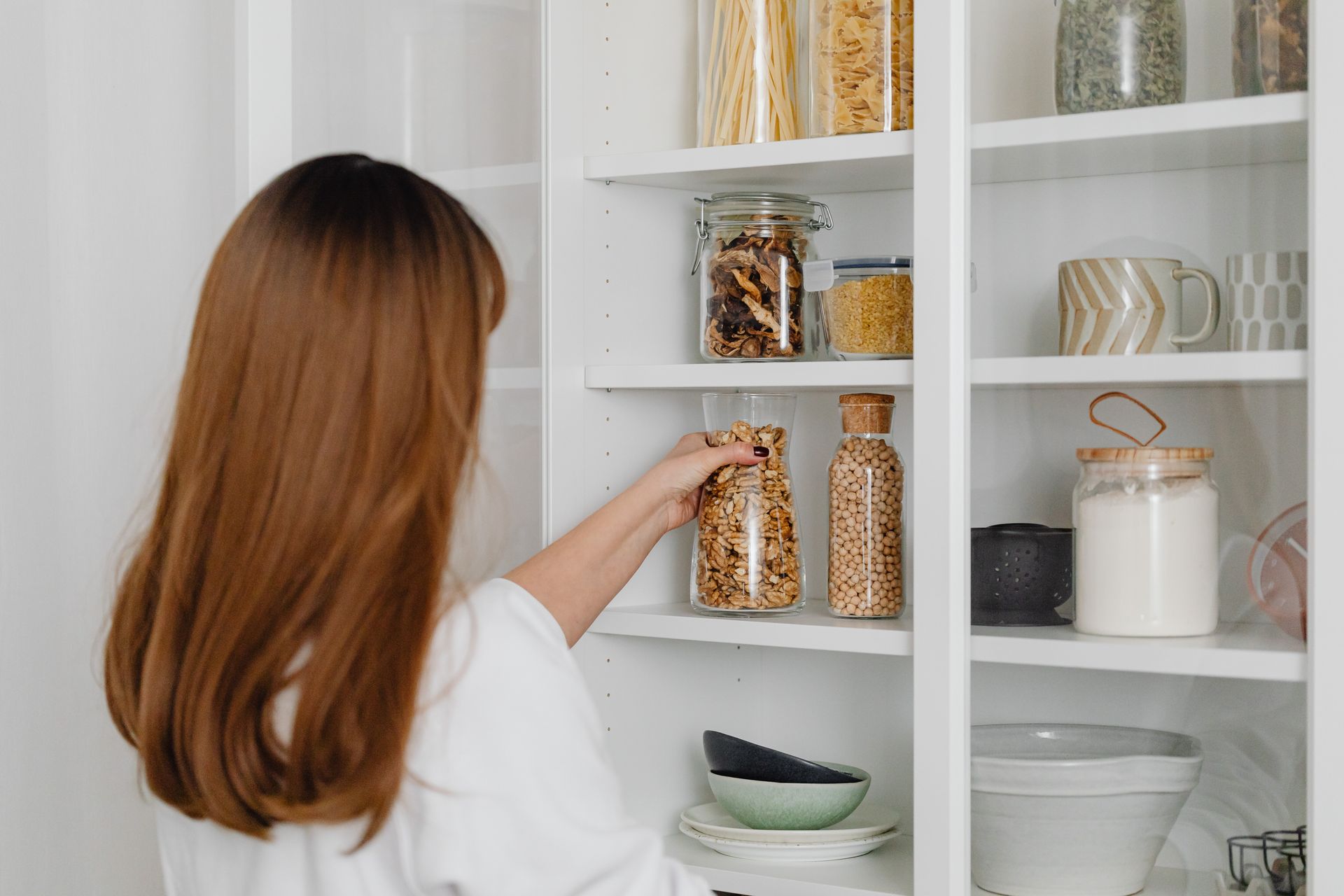
You didn't finish "everything" but you got a ton sorted, all your jars are facing the same direction in your pantry, and everything looks just like your favorite Instagram expert's home now, too.
I mean, if she can do it, you can do it, right?
Of course you can.
And you collapsed on the sofa, scanned your living room and were really proud–and pretty tired–as you enjoyed the view.
Sunday was a relaxing day with the family or maybe a solo outing.
Then Tuesday happened.
It felt like stuff was flying at your face all day long and all you could do was play dodgeball with your stuff and try to survive.
And now it's Saturday and there's crap piled up on the kitchen counter, that comfy chair by the window looks like your closet threw up on it, and that damn drawer in the kitchen won't close again.
Sound familiar?
Here's the part nobody wants to say out loud: you were trained to expect this. Crave it even.
Every organizing show I’ve ever been on is built on this premise.
You’re a hot mess.
You get an intervention.
Everything is beautiful, and organized, and together.
We all celebrate—yay, we did it!
Everything falls apart again.
It’s why I refused to be on Hoarders.
And every organizing video you've ever watched follows the same script.
Overwhelming disaster.
Dramatic music.
Sped up sequences of all the work.
Gorgeous reveal.
Confetti.
Done.
It's Extreme Makeover for your junk drawer.
That's not organizing.
That's Humpty Dumpty with better lighting and a soundrack.
Or what I call yo-yo organizing.
Same as yo-yo dieting—lose it, gain it back, lose it again, and somewhere in that cycle you start mistaking the cycle itself for the process, instead of recognizing it as the failure it actually is.
Nobody's filming themselves putting the scissors back in the drawer the second they're done with them.
There's no before-and-after in that.
No music swell.
No dopamine hit.
So we skip it.
We let it pile up, because piling up is what earns you the satisfying reveal later.
The mess isn't an accident.
It's the price of admission for the part we actually enjoy.
I want you to think about what you actually tell yourself in the exact moment you're holding something and deciding whether to put it away right now.
I'll do it later.
I'm too tired for this today.
I'm too busy right this second, I'll get back to it.
I'm too spontaneous, too free-spirited to live by someone else's rules.
I’m the boss of me.
You sure are.
I've said every one of those to myself, too.
And then I say this:
Winners do what they have to do, everyone else does what they want to do.
It’s not sexy but it sure gets me up off my butt and finishing whatever it is I wanted to walk away from.
As soon as I started using Grubhub and Doordash, I recycled the binder of takeout menus—didn’t need ‘em anymore.
I didn’t leave them in the bottom drawer of the stove until I “got around to it.”
And here's the math nobody wants to run: keeping something organized takes a fraction of the time it takes to reorganize it from scratch.
Putting the scissors back costs you four seconds.
Finding the scissors three weeks from now, after they've migrated to a junk drawer, the bottom of a backpack, and finally hiding in some random laundry pile (?!), costs you considerably more than four seconds—and probably a few choice words—mostly directed at yourself.
What a loser you are,
How lazy you are.
What is wrong with you?
I wouldn’t be motivated to do much either with that stream of meanness directed at me.
It’s no wonder you feel demoralized and like a failure.
You’ve been telling yourself that for longer than you probably want to admit.
But here’s the thing.
Maintenance is cheap.
Recovery is expensive.
Emotionally expensive.
Time expensive.
And sometimes money expensive, too.
But, for all the costs involved, we keep choosing the expensive one because it comes with a big reveal, a juicy shot of dopamine, and the cheap one doesn't.
Think of it like raking leaves in October when they first start to fall instead of waiting until every last one has dropped in November.
Doing it a little at a time, continuously, is boring.
There's no single triumphant afternoon where you clear the entire yard and post the after photo.
You just... keep doing it.
This way, your yard never turns into the disaster that needs the triumphant afternoon in the first place.
So you don’t get the big rush of exhausting yourself …
And you don’t exhaust yourself.
Funny, right?
That's what maintenance actually feels like.
And I get it.
Having to stop while I’m writing this to go get lunch and then clean up can feel tedious.
Like, didn’t I just do this already?
How did the kitchen get so messy, all I made was one freaking sandwich.
So, I do get it.
It's not glamorous.
It's repetitive.
It's predictable.
It can feel dull and flat and like a waste of time.
Like making the bed.
You’re just going to get back into in in 12 hours—why bother?
And we've been trained by literally everything else in our lives—social media, entertainment, marketing—to treat repetitive and predictable as a personal failure instead of exactly what it is: the thing that actually works.
Who wants to be boring?
Because we're wired for novelty.
That's not a character flaw, that's just how brains work.
The problem is where we've been going looking for it.
We don’t have to hunt and gather anymore—we just have to go to Costco or Sam’s Club and bulk up.
So we manufacture fake novelty where we’re in control—at home.
We read magazines, we scour the internet for the latest in bins, seeking out new fresh systems, a whole new "aesthetic" for the pantry—when what we actually crave is out in the world.
And again, I get it.
It’s scary out there.
In here it’s safe.
And you get to play house.
Just like they taught you in kindergarten.
So instead of taking all the time we could be saving with a functional home to explore a new trail or have a new conversation with someone we don’t see enough …
Or checking out a new restaurant or even reading a new book …
We create a mess so we have something to do.
Your home was never supposed to be the source of stimulation in your life.
It was supposed to be a nest—the quiet, functioning place you come back to after you've gone and had an experience.
I'm not going to lay out the whole maintenance system here—how to actually make "put it back" as automatic as it needs to be to stop this cycle for good.
That's a real process, not a paragraph.
But I will tell you this: you don't need another home transformation.
You've had plenty.
What you need is to stop chasing the latest trend and transform yourself, instead.
Not as sexy or fun perhaps, but a lot more rewarding for sure.
So—are you the kind of person who wants to build the maintenance habit yourself, at your own pace, without waiting for the next collapse?
Or are you ready to break the cycle for good, live, with me, this week?
If it's the first one, my Wall Street Journal best-selling book Unstuff Your Life! walks you through the entire system—including exactly how to make maintaining it as automatic as it needs to be.
Get Unstuff Your Life! here → https://www.amazon.com/dp/B0DQ2P1YS9?linkCode=ssc&tag=andrewmelleni-20&creativeASIN=B0DQ2P1YS9&asc_item-id=amzn1.ideas.3NPT054JW2UKT&ref_=aip_sf_list_spv_ons_mixed_d_asin
If it's the second one, the De-Stress Your Mess Challenge gets you off the yo-yo for good, live, with me.
Join the DYM Challenge here → https://go.andrewmellen.com/dym
Conquer Your Clutter in Just 5 Days!
In 5 days, with ZERO overwhelm, you can tame your clutter with my simple, easy-to-use system.
Unlike those other quick-fix bandaids, THIS system solves the root cause of clutter—so it's gone for good.
For details about the next challenge, click the button below.
Video replays available 24/7 ... so you'll never miss a thing!
.png)


Why Your Home Feels Overwhelming After You've Decluttered
You organized everything and it still doesn't feel calm. Here's what's actually running the show behind the clutter — and how to fix it for good.
Read the article →
How to Keep Your Kitchen Counters Clutter-Free
A cute basket won't fix it. Andrew Mellen on why your kitchen counter becomes the default home for everything without one—mail, keys, chargers—and how to actually stop it.
Read the article →
The Woman Who Mistook Her Life For a Handbag
A client's handbag weighed nine pounds. Andrew Mellen on the difference between what we carry and what we're actually afraid to lose—inspired by Oliver Sacks' The Man Who Mistook His Wife for a Hat.
Read the article →
How to Organize an Entryway (So It Actually Stays That Way)
Cubbies and hooks won't save you. Andrew Mellen on why your entryway falls apart within days of cleaning it—and how to build one that actually holds, whether or not you've got kids and backpacks.
Read the article →
How to Declutter a Messy Garage
A bigger garage won't fix it. Andrew Mellen on why your garage became a dumping ground for every decision you didn't want to make—and how to actually clear it, one timer at a time.
Read the article →Why Can't I Keep My House Organized?
Getting organized isn't the problem. Staying that way is. Andrew Mellen on why we're addicted to the dramatic reveal and allergic to the boring maintenance that actually works.
Read the article →