
Where to Start When You're Downsizing (Whether You Chose It or Not)

At some point in each of our lives, a clock starts regarding 'stuff.'
Sometimes you start it yourself.
You decide that you're done acquiring and ready to start investing your money on experiences instead of things.
You decide it's time to retire, or relocate, or trade the four-bedroom house for something that takes an hour to clean instead of a weekend.
Sometimes the clock starts because you set something in motion.
You put the house on the market, and now there's a closing date you agreed to, even if you're a little freaked out by how fast it's coming.
And sometimes the clock starts without asking you anything at all.
A doctor tells your parent that stairs aren't a good idea anymore.
A lease doesn't get renewed.
A job moves you across the country in six weeks.
Three different scenarios that start a very similar clock ticking.
And suddenly that old story that goes, "someday I'll deal with all this stuff" just became "you have until the 14th to get this stuff out."
THE REAL DIFFERENCE ISN'T PLANNED VS. UNPLANNED
It can seem that that's the distinction that matters, but it's not.
It's not chosen vs. forced.
Welcome vs. unwelcome.
Victim vs. hero.
It's open-ended versus finite.
If you decide, on your own, with no external pressure, that you want to downsize—that's your choice and unless you create a deadline, it floats out there open-ended.
There's no clock ticking … audibly.
Of course it is ticking, but between denial and avoidance, it's pretty faint and in the background.
So that means you can take a year, or 10 years … on the surface it doesn't matter.
And if you set something in motion yourself, like selling the house, that decision was still yours, but it's no longer open-ended because the outcome doesn't only involve you.
You might have started the clock but the negotiation between you and the buyer determined when that clock would stop.
You can't just pause or stop it once it's running.
At least not without consequences.
And if the deadline came from somewhere else entirely—a health diagnosis, a landlord, an employer—that's imposed.
It too is often finite, and your ability to negotiate with that clock is sometimes far more constrictive or non-existent.
It's worth noting here that "imposed" doesn't automatically mean "unwelcome."
A closing date on a house you're excited to sell is still a hard deadline.
It's just one you're at peace with.
But the volume of stuff in front of you doesn't know which version of the clock is ticking.
And if you pile a bunch of feelings on top of that clock, that deadline usually only feels tighter.
And when you're feeling squeezed, you're likely to tell yourself a new old story.
All those deferred decisions, all those piles and stacks and boxes and bags prove that you waited too long to act.
Or that you're just no good at this, whatever this is.
Or that your worst fears about yourself are really true.
And that if anyone walked into your house, they would know it now, too.
WHY THIS ISN'T LIKE OTHER CLUTTER
With every other kind of clutter situation, there is no inherent clock ticking.
Beyond its impact on your well-being, no one is tracking how long those paper piles hang around.
That slightly smelly teddy bear or chipped tea cup can sit in a box and no one's going to ask you when you're going to get around to sorting through it.
Downsizing is different specifically because of the clock, whichever kind of clock you're dealing with.
And even the gentlest, most welcome version—retiring, relocating, finally trading stuff for freedom—still has an end date attached to it once the movers are booked, the new place is signed, or the tickets booked.
So this isn't just a bigger or more urgent version of "where did I put my keys again?"
This is every deferred decision suddenly showing up on your doorstep with a ticking time bomb attached to them.
That's why you feel like your head is about to explode when you contemplate the volume of stuff you need to deal with and the speed with which you need to act.
It's a bitch to have to pay all that time-debt back at one time.
All we can hope is that you enjoyed everything you did instead of making those decisions in real time.
Because you're about to start paying for it now.
THE FIX THAT ISN'T A FIX
So when that really becomes clear, you may go into overdrive thinking that the quickest fix for your panic and terror is to start attacking by volume.
Rent a dumpster.
Hire a bunch of guys to haul it all away.
Hire a senior move manager or professional organizer who shows up with a truckload of boxes and their own agenda.
I've seen this exact scenario play out with private clients more than once.
Most move managers are professional, committed to being efficient, and hopefully even kind.
Ditto for pro organizers.
But very few of them have the skill to successfully shepherd you through this process and project manage a move simultaneously.
What often happens is, by day two, half the house is packed into boxes labeled "misc," or "bedroom" because that's the room they found it in.
And those miscellaneous boxes?
Those are all the decisions you made at the end of the day when you were either distracted or exhausted and ready to be done.
And your professional help was more concerned with how you felt in the moment than holding you compassionately but firmly accountable for making a real decision before loading a box.
So you pivot to the story that you'll just make all those decisions once you unpack on the other side.
Doing that will be a colossal waste of time and money, I promise you.
In the meantime, you and your helpers are searching for the one good pair of scissors you kept out to use and hoping they aren't in one of those "misc" boxes.
Volume-first feels productive because it gets furniture out of the way and every box seems like visible progress.
But packing an item as a stand-in for a decision you haven't made yet isn't actually a decision.
It's just another deferral headed for a moving truck at $140 an hour plus mileage.
And guess whose name is on the invoice.
THE ONE LENS THAT ACTUALLY TELLS YOU WHERE TO START
Almost every downsizing situation comes down to one of two factors: you're short on time, or you're short on money.
If you're short on time, it's probably going to cost you more money to do it fast.
If you have plenty of time and not a lot of money, you can be thorough.
But you run the risk of things taking longer than they need to, because you can't afford to speed them up.
PRIORITIZE, OR YOU PAY FOR IT TWICE
Here's the part that matters more than which clock you're on, or which side of the time-and-money line you're standing on.
If you don't prioritize, you will burn hours, or dollars, or both, on things that don't actually move you closer to finished.
That looks like alphabetizing a bookshelf when you still haven't locked down a moving day.
Deep-cleaning a garage you only need to leave broom-clean.
Agonizing over the best home for a drawer full of "good" pens while the dining set nobody wants is still homeless with no prospects in sight.
Other than the garage, all of those things will need to be completed before you leave.
But none of those tasks should be first.
Prioritizing means deciding, before you touch a single thing, which decisions actually determine whether this move goes well and according to plan—and which ones, if you never made them, wouldn't materially affect the outcome.
Otherwise you've just added a bunch of unnecessary interest to your already looming decision debt.
FLIP THE ORDER
Here's what actually works, and it's the reverse of how almost everyone starts, no matter which clock got them here.
Decide first.
Pack second.
And the question that starts the entire process is this:
"What does the next chapter of this life actually need to hold?"
Not what do you already own?
What do you need to live a rich life?
A studio apartment doesn't need a dining table that seats twelve, no matter how many holidays have happened around it.
An Airstream or motorhome doesn't need a sectional sofa, regardless of how beautiful or comfortable it is.
An assisted living unit doesn't need the toolbox from a garage workshop, no matter how many projects they helped you complete in the past.
Once you know where you're going and how you want to live there, it's much easier to evaluate four years or four decades of belongings.
And, again—you're asking one simple question about each thing: does this belong to the life I'm moving into, or the life I'm moving out of.
That single reframe is what makes prioritizing possible in the first place — you can't decide what matters and will be useful until you know what the next chapter is designed for.
THE GUILT UNDERNEATH THE URGENCY
Here's the deeper why, and it rarely shows up as guilt about the stuff itself.
It shows up as guilt about your historic choices and what the clock seems to be accusing you of, even when you're the one who started it.
If you're downsizing your own home and moving somewhere with assistance or less independence, some part of you may be quietly mourning a chapter that's ending even though you're the one who ended it.
If you're downsizing a parent's home, you may be doing it while they're standing right there.
So you're navigating your relationship with them as they're watching decades of their lives get sorted into piles.
So the dissonance shouldn't be surprising between the most practical utilitarian view—where memories feel like extra weight, not something to celebrate.
And the cushy, soupy view where everything is precious and a touchstone to another significant moment.
And if multiple family members are involved, everyone shows up with their own attachment and stories about the same objects, which means every decision has an audience and possibly a different point of view, too.
And for all of it, none of it is really about the couch, or the table and chairs, or the tools in the garage.
It's about mortality, autonomy, and being watched at a particularly vulnerable moment.
I never tell my clients what to keep and what to let go of.
That's true here more than almost anywhere else, especially when the clock is ticking.
In these situations, time creates urgency and humanity demands patience, grace and thoroughness.
So remember this: the clock isn't judging you, even the one you started yourself.
It's just a point in time.
The shame you're feeling standing in the garage isn't coming from the calendar.
It's coming from a much older story about what it means to need help, or have limited time, or let go of a version of your life that you want to release—just on your own terms and a bit slower than you're being asked to.
MAKE THE DECISION, NOT THE INVENTORY
None of this makes packing any easier.
It just means that packing stops being where you think the real work is happening.
Decide what the next chapter needs.
Prioritize the decisions that actually matter before you waste time on the ones that don't.
Sort like with like so choices are about function, not about who gave you what or who used to sit at that table.
Assign what's staying to a real home in the new space before it arrives, not after.
And let the rest go with actual permission instead of guilt, shame or regret.
Donated, sold, passed to someone who'll use it, or simply released, it's all getting another life, just like you are.
So hopefully now you can see that the volume isn't the hard part.
The hard part is deciding who you are, who you want to be, how you want to live, and what serves you in that new life.
After that, a spatula or a sofa is almost child's play.
If you want a system that walks you through exactly this kind of decision-making, at whatever pace your situation allows, start with Unstuff Your Life! here → https://www.amazon.com/dp/B0DQ2P1YS9?linkCode=ssc&tag=andrewmelleni-20&creativeASIN=B0DQ2P1YS9&asc_item-id=amzn1.ideas.3NPT054JW2UKT&ref_=aip_sf_list_spv_ons_mixed_d_asin.
If you'd rather have real-time support while you're up against a real deadline, you may want to consider some individual coaching. You can learn more about that here → https://go.andrewmellen.com/deep-dive-coaching
If this topic seems far away, and you just wanna tackle some regular everyday clutter, why not join us for the next De-Stress Your Mess Challenge: https://go.andrewmellen.com/dym
And if what trips you up after answering the big questions is should I keep it, sell it, or give it away — the Declutter Decider app was built for exactly that. Find it here → https://declutterdecider.com
Set a timer.
Decide what the next chapter needs.
Prioritize from there.
That's the best way to start.
Conquer Your Clutter in Just 5 Days!
In 5 days, with ZERO overwhelm, you can tame your clutter with my simple, easy-to-use system.
Unlike those other quick-fix bandaids, THIS system solves the root cause of clutter—so it's gone for good.
For details about the next challenge, click the button below.
Video replays available 24/7 ... so you'll never miss a thing!
.png)


How Does Clutter Affect Your Mental Health?
Clutter affects your mental health because every decision you've postponed keeps running in the background. Here's how to start closing those open tabs—15 minutes at a time.
Read the article →
How to Organize Your Closet Without Buying Anything (Even When Swapping Seasons)
The seasonal closet swap moves the same undecided clothes back and forth twice a year. Here's how to turn it into a checkpoint and stop paying the swap tax.
Read the article →Where to Start When You're Downsizing (Whether You Chose It or Not)
Downsizing isn't a bigger decluttering project — it's a decision problem with a clock attached. Here's how to prioritize so you don't waste time on the wrong things.
Read the article →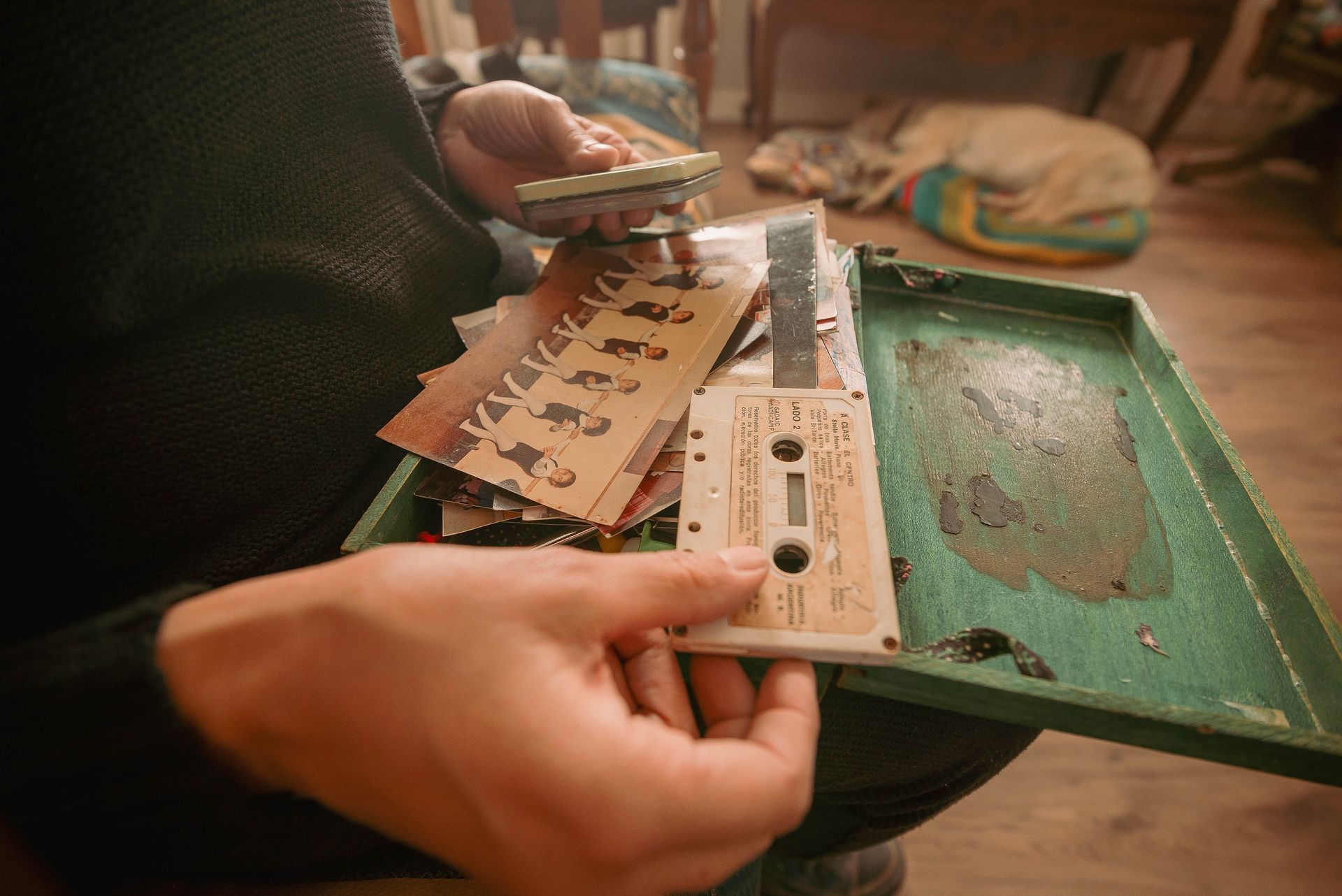
How to Let Go of Sentimental Items (Without the Guilt)
Letting go of sentimental items isn't about being ruthless — it's about separating the memory from the object. Here's the actual reframe that makes it possible
Read the article →
How to Organize Paper Clutter (Before It Takes Over Your Life)
The pile isn't a filing problem — it's a decision problem. Here's why paper clutter is so hard to face, and the actual system that ends it for good.
Read the article →
Why Your Home Feels Overwhelming After You've Decluttered
You organized everything and it still doesn't feel calm. Here's what's actually running the show behind the clutter — and how to fix it for good.
Read the article →