
How to Let Go of Sentimental Items (Without the Guilt)
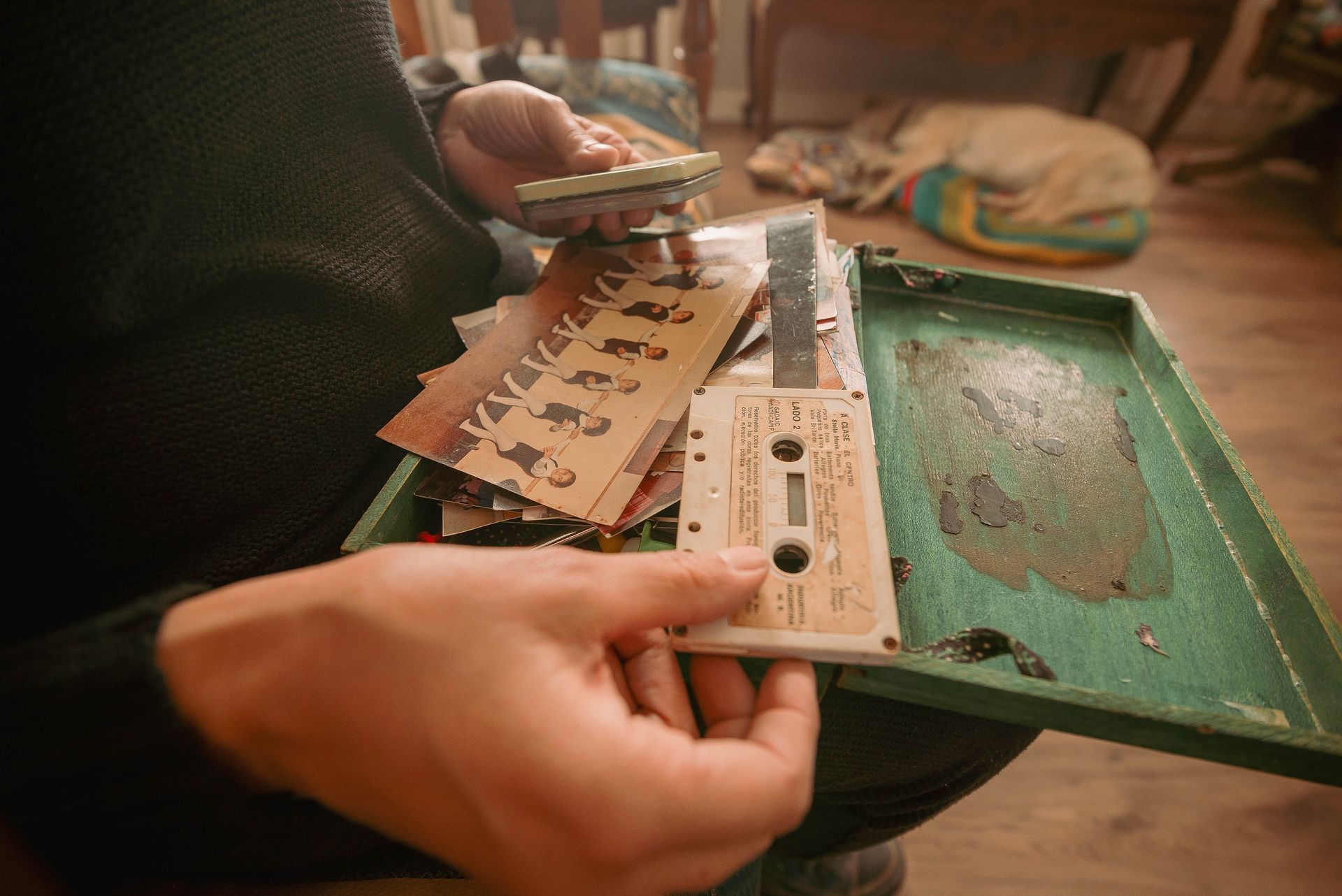
For the past few weeks, we've been looking at different kinds of "stuff."
This week, let's look at some of the stickiest stuff—sentimental items.
That includes mementos, heirlooms, and other items directly tied to story and our lived history or past.
Right now, there's very likely a box in your closet, or your attic, your parents' garage, or possibly the bottom drawer of a desk and even more likely, it has your name on it.
Or maybe your initials.
Or a sticker or some other identifying marker that claims it as yours.
It might be an old cigar box or a cookie tin. It might be quilted or plain old cardboard.
And inside it could be any of these items:
A lucky rabbit's foot
A keychain with no keys
A charm bracelet
A friendship bracelet
Something you made at camp
Ticket stubs from some live event
Abandoned jewelry
A lock of hair and/or some baby teeth
You may have other boxes with dolls, stuffed animals, clothing from when you or someone close to you was small, a baby blanket, T-shirts with something commemorative printed on them, concert ticket stubs, high school yearbooks … you get the picture.
Chances are, you haven't spent much time in these boxes in a while, possibly years.
And, the only reason you'd open one of them today is because you read this here and it spurred you on to go looking.
Most of the things in these boxes represent a significant moment or era in your life, hopefully, and almost without exception, these events are in the past.
Often, in the distant past.
For most of us, we don't want to go back there, but somewhere deep inside, we are afraid that the present will lose some of its depth and richness if those tokens and totems from the past were to disappear.
Barring dementia, or some other memory disorder, that's unlikely—but the story is powerful nonetheless.
And the point of this is not to suggest or encourage you to let any of those things go—simply to bring your attention to them so their continued significance is earned rather than assumed.
Otherwise, like old lovers, we may think of them fondly, but we'd probably prefer to not run into them in the bright light of the day.
And for other items, they may be more like distant relatives, parked in a nursing home somewhere.
You may feel tethered to them in a way, but if you think about it too long, some small part of you may flinch, just slightly, like you owe them a visit it's easier to avoid.
WHY THIS ISN'T LIKE OTHER CLUTTER
With several of the recent articles, we've talked about how a particular topic is distinct and not like random, everyday clutter.
And I'm sure you can find generic advice on social media that suggests the easiest way to deal with sentimental items is to use color-coded bins with decorative labels.
Or from a minimalist perspective that just getting rid of most of it, with or without taking photos first, is the way to go.
Just sort through them, box them up or toss them, label what stays, and call it a day.
But these kinds of things are not cleaning products, towels or socks.
I have a private client, let's call her Janice—not her real name—and a professional organizer she hired had her buy a bunch of flimsy cardboard boxes in three colors: red, blue, and green.
As lightweight as the boxes were is how heavy-duty the metal handles were.
Which just added more weight to the structure of the boxes—poor design for sure.
There was no logic to which color these organizers used for the contents.
So she had some large random containers that you couldn't see through with uncategorized contents.
Which rendered them worse than useless because this "method" actually created more confusion.
The only thing they did was "look" good—meaning you could stack them if they weren't too heavy.
We ended up using them as sorting bins without their lids—that was their best use.
So colored bins, regardless of whether they are specific to a category or not, are not a great choice.
While I'm not a huge plastic fan, clear sturdy containers you can see through are almost always going to be the better choice.
But back to sentimental objects specifically.
When sentimental stuff becomes clutter it's extra sticky because almost always the object was never the most important or significant component.
So what is the sticky part, the significant part?
That's the stuff behind the stuff.
A drawer full of takeout menus is always just a drawer full of takeout menus.
Nobody's identity is riding on it.
Even if you're a foodie.
But that shirt isn't just a shirt.
It's a document from a very specific place or time or event or any/all of the above.
And as documentation, it captures or represents a very specific version of you.
No doubt you were younger.
But what else does it signify?
Were you freer?
Had more money?
Less money?
Were you in love?
Were you recovering from a breakup?
Were you in school?
Married?
Divorced?
With your family?
With friends?
On a trip?
At an event?
If you let go of the shirt, some part of you is afraid you're letting go of all that data, too.
But you don't probably think of it as data points, you think of it as memories.
Good memories, bad memories, happy memories, sad memories.
The object is what you've anchored all those memories—thoughts, feelings, senses—to.
So at that point, what to do with the shirt isn't really a storage problem.
I mean, you may not have physical room for that specific shirt.
But what's keeping that shirt around is not logic.
It's the thoughts and feelings bound up in the shirt.
And logic doesn't stand a chance against either of those.
THE THING THAT ACTUALLY HELPS
So what does stand up to thoughts and feelings?
First let's zoom out.
Here's where I'm going to disagree with any expert who tells you to just be ruthless about sentimental items.
Ruthless is the wrong instrument for this job.
You don't take a chainsaw or a hammer to a memory.
What actually helps is separating the object from what it's carrying.
The sweater from your ex doesn't hold the relationship—you do.
The sweater, at its most basic level, is just a bunch of yarn.
The stack of birthday cards doesn't hold your grandmother's love for you.
You already have that—it's yours, it lives in you, it was never dependent on Hallmark.
Once you can see the object and the memory as two separate things, you get to make a decision about the object that has nothing to do with losing, forgetting or worst of all, betraying the memory.
One technique is to keep the thing that represents the whole collection best—one card, not 40.
One photo from the trip, not a shoebox of 300.
The watch, wound one last time, then let go, or kept and worn, your call—but a decision, either way, instead of a box you can't bring yourself to explore.
You can always take a picture of any item you're releasing, if the image will be good enough to stand in for the object.
A picture of the shirt takes up a few megabytes of storage which is certainly smaller than how much room it takes up in your closet.
And it does the exact same emotional job.
Whatever you decide, remember that you're never throwing away the memory.
Because the memory was never the shirt or thing to begin with.
THE GUILT BEHIND THE GUILT
Here's the deeper why, and it's seldom what people expect it to be.
Because we're all pretty equally self-involved and self-invested, the item is rarely exclusively about missing the person or the moment.
It's about what letting go might say about you.
And mostly to you as well.
If you give away your mother's china, does that mean you didn't love her enough to keep it?
If you finally get rid of your ex's sweater, does that mean the relationship meant less than you thought?
If you let your kid's homework and scribbles go to recycling, are you a bad parent for not treasuring every single piece of construction paper they ever touched?
None of those questions are really about the object.
They're about a fear of being judged—by the person who gave it to you or made it, or by some imagined jury of people who'd think less of you for not keeping everything forever.
Or most likely, by yourself, who is the harshest critic of all.
I had a client, Cheryl, who went through her childhood home after her dad passed, so her mom could relocate and they could sell the house.
In trying to decide what to bring home with her, she established five criteria:
- Was the item better than what she already owned?
- Was it more attractive than what she already owned?
- Was it more valuable than what she already owned?
- Was it more meaningful than what she already owned?
- Was it something she genuinely needed and didn't already have?
If an item didn't meet any of those five, she let it go, and she made her peace with it.
Because, as she put it, the item might have been around during her childhood—but it wasn't her childhood.
That's the reframe.
You're not the custodian or guardian of every object that ever touched your life.
You're the owner of your own memories, and those don't require physical evidence to remain real.
Let me remind you, I never tell my clients what to keep and what to let go of.
That's not my call, and it's not anyone other than the client or in this case, yours, either.
It's not up to your sister, your spouse, or some stranger to decide or declare what a "sentimental" person, meaning a "good" person, is supposed to hold onto.
But I will tell you this: if you're keeping something purely so you don't have to feel like you're capable of letting it go, that's not sentiment.
That's obligation dressed up as love.
STEWARDSHIP, NOT OWNERSHIP
There's a version of this where you get to think of yourself as a steward or curator instead of an owner.
A steward holds something for a while, takes care of it, and then passes it along—to someone else who'll use it.
That could be as a donation, or via recycling, or simply documented as a photograph.
And a curator is looking for the best representative of an era or other period of time.
You'll never see a museum or gallery show of every work of art by an artist.
The curator works to shape your experience of the artist as much by what is displayed as by what is omitted.
Contrast that with how an owner thinks.
An owner thinks about possession primarily.
That each item is an asset.
And that protecting the investment or the value of the item is the most important activity.
From that point of view, the best way to honor something is to keep it forever.
Even if that means it lives in a box, unopened.
And even if part of the cost of saving the item is that flinch or clutch in your stomach every time you see the item, the box or think about it.
Stewardship and curation are both lighter.
Stewardship doesn't ask you to keep everything.
And curation doesn't ask you to display everything.
They ask you to be honest about what you're actually holding onto, and why, and where precisely each thing should live in your life.
On a shelf, on a surface, carefully wrapped and in storage or released to the greater world.
So, if you're honest with yourself, most of what's in those boxes has already done its job.
We don't rely on a thing to remind us or comfort us.
We rely on ourselves to do that.
And even if the item got you through something significant in the past, that doesn't mean its job is to keep doing that forever.
You've probably heard this quote before:
"Don't cry because it's over; smile because it happened."
Ludwig Jacobowski wrote it in a poem, not Dr. Seuss.
But regardless of who said it, the sentiment holds.
Just because something happened at some point in your life, you don't need an object to keep the memory alive.
That's your job.
And if it's not a job you want, then maybe you don't need to keep the item any more, either.
If you working through sentimental items with a system that respects both the memory and your need to move forward sounds good, you'll find great instruction and guidance in Unstuff Your Life! here → https://www.amazon.com/dp/B0DQ2P1YS9?linkCode=ssc&tag=andrewmelleni-20&creativeASIN=B0DQ2P1YS9&asc_item-id=amzn1.ideas.3NPT054JW2UKT&ref_=aip_sf_list_spv_ons_mixed_d_asin.
And if DIYing it sounds like too heavy a lift and you want some live support, that's exactly why I built the De-Stress Your Mess Challenge™.
5 days, real decisions, and real momentum, too.
Because sometimes sentimental decisions are harder to make alone.
You can join me for the next one here → https://go.andrewmellen.com/dym
And if you get stuck deciding what to actually do with something—keep, sell, or donate—the Declutter Decider app was built for exactly that.
Find it here → https://declutterdecider.com
Whichever path forward, start by setting a timer.
Open one box at a time.
It's the simplest way to begin.

How to Declutter Your Digital Life
Decluttering your digital life means making decisions about the files, photos, apps, and emails you've been saving by default. Here's where to start—15 minutes at a time.
Read the article →
Menopause Brain Fog and Forgetfulness: How to Stop Losing Things
Losing your keys, glasses, or files isn't always about your memory. Andrew Mellen explains how giving everything one home lets your system do the remembering—even on a foggy day.
Read the article →
How Does Clutter Affect Your Mental Health?
Clutter affects your mental health because every decision you've postponed keeps running in the background. Here's how to start closing those open tabs—15 minutes at a time.
Read the article →
How to Organize Your Closet Without Buying Anything (Even When Swapping Seasons)
The seasonal closet swap moves the same undecided clothes back and forth twice a year. Here's how to turn it into a checkpoint and stop paying the swap tax.
Read the article →
Where to Start When You're Downsizing (Whether You Chose It or Not)
Downsizing isn't a bigger decluttering project — it's a decision problem with a clock attached. Here's how to prioritize so you don't waste time on the wrong things.
Read the article →How to Let Go of Sentimental Items (Without the Guilt)
Letting go of sentimental items isn't about being ruthless — it's about separating the memory from the object. Here's the actual reframe that makes it possible
Read the article →