
The Woman Who Mistook Her Life For a Handbag
Dr. Oliver Sacks wrote a pretty wonderful book called The Man Who Mistook His Wife for a Hat.
It's about patients whose minds played tricks on them so completely that they lost track of what things actually were.
I've spent 30+ years watching a quieter version of that same confusion happen to perfectly healthy people, over and over, in their own homes and lives.
I once worked with a woman whose bag weighed almost nine pounds.
Let's call her Phyllis—and no, that's not her real name.
How do I know how much Phyllis' bag weighed?
Because I made her put it on a bathroom scale—sort of.
I don't make anyone do anything.
I just suggested that we weigh her bag.
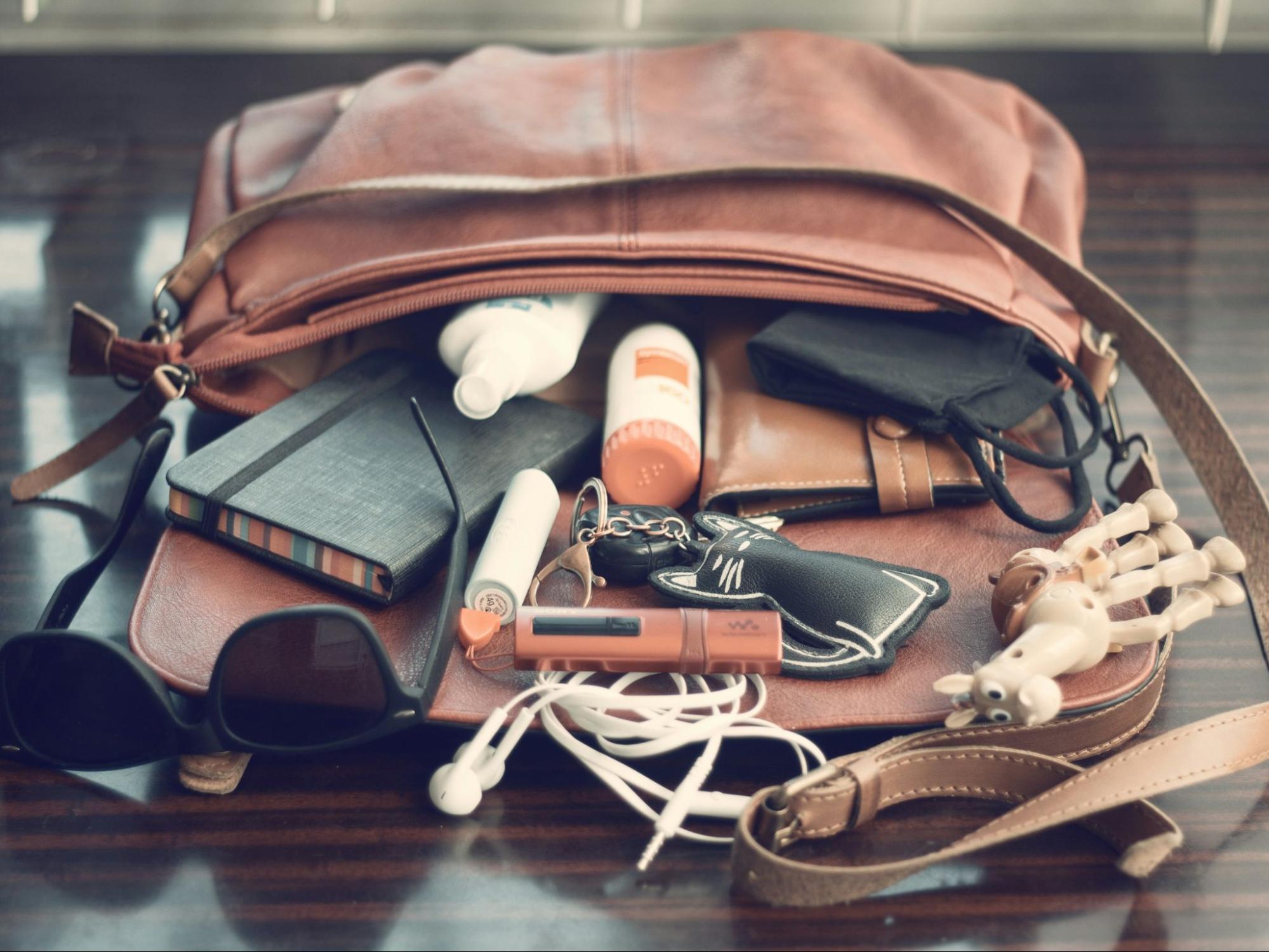
And here's what she was carrying around every day.
Because, surprise, she never really emptied the bag, just shuffled contents a bit.
And it seems like her SOP was, once it was in the bag, it stayed in the bag.
A bizarre twist on The Organizational Triangle®'s "One home for everything."
So she had her current wallet in there—makes sense.
She also had two other wallets, frayed and retired, but she couldn't bring herself to throw them out because they were once "nice"—her word, not mine.
A small tangle of cords for phones she no longer owned—3 to be exact.
Receipts going back over two years.
Not business receipts—receipts for snacks from the drugstore, a random shoe repair, equally random battery replacement for a watch she no longer wears or owns.
FYI, these were loose in the bottom of the bag, not inside one of the three wallets.
Speaking of threes, there were 3 partial lipsticks in the same shade.
One, in particular, was pretty gross with lint and eyebrow pencil shavings mashed into the stick.
There was a paperback she'd been "in the middle of" for so long she'd forgotten the plot.
No bookmark though, so we couldn't figure out where exactly in the book she had left off.
A 12 oz. plastic bottle of water—not refillable and not full.
Random mints, coins—domestic and foreign—some bandaids and a used ace bandage, and a set of keys to a house in another state.
I asked her why she carried all of this around with her.
And this is what she said, and I remember this exactly because it was so simple and stated matter-of-fact: I might need this stuff.
No irony. No self-deprecating smile or smirk.
Just a simple, earnest statement.
Not she does need it.
Just she might need it.
Someday. Maybe. Possibly. Or possibly not.
That's a lot of weight to be carrying around for contingencies.
There's a part of me that admired her commitment to being prepared.
It's as if she were arming herself like a soldier for battle with any and every possible provision.
I know we often refer to ourselves as clutter warriors, but she's not fighting a real war.
Which is also telling when we really look at her mindset.
Because once we started to sift through some of her 200 lies, we uncovered that she did feel like each day was a battle for survival.
On some level, making it home safe and in one piece meant she had to have every possibly contingency covered.
Even on days she was just going to work and coming straight home.
No stopping for groceries, or to the gym, or the pharmacy.
Just a day that had very little variation or potential for danger in it.
So, at that point, it's no longer a handbag.
It's a version of her life she was hauling around.
And not the life she was actually living.
Imagine the weight, not only of the nine pounds on her shoulder, but the emotional, mental and spiritual weight of all those potential catastrophes.
The weight of all that potential was exhausting to me, and I wasn't carrying a thing.
Is it any wonder she left home feeling beleaguered and came home feeling like she'd just run a gauntlet?
So here's what I think happened to her, and to a lot of people I've worked with over the years: somewhere along the way, stuff stopped serving her and her life and started becoming her life instead.
She was so afraid of life itself, let alone being under-prepared, that when she walked out of her house she took every possible thing with her… just in case.
Now I was never a Boy Scout but I'm all for preparation.
It's the antidote to anxiety.
But the kind of anxiety that's tied to a specific task or event.
That kind of anxiety is likely to undermine your ability to focus—it's a form of worry that drives you literally to distraction.
That's not what was going on with Phyllis.
Hers was not event-specific anxiety.
It was generalized anxiety.
And no amount of preparation will ever ward off that degree of fear.
Because literally everything was a potential danger.
Now, medical intervention might help here—and I don't necessarily mean drugs.
But help from professionals who know how to treat generalized anxiety disorder.
Otherwise, this becomes the 21st-century version of Chicken Little.
And I say this with deep compassion, if the sky really is falling, that third tube of lipstick is not going to make any difference.
Nor is the assortment of loose change or the dusty, fuzzy mints.
There are the things you are likely to encounter in a typical 8 to 12 hours away from home.
And then there are other things that are very unlikely to occur.
It's that second set of things that may be keeping you agitated and off-balance.
So at this point, those extra lipsticks weren't for wearing.
They were insurance against a version of herself she was afraid to lose or a version of herself she was afraid to become.
Two sides to the same coin.
The retired wallets?
They were proof that she'd once been the kind of person who bought nice, meaning expensive, things.
The unfinished paperback wasn't for reading.
It was evidence that she was a "person who reads," even though she hadn't opened it in months.
None of it was really about the objects.
It was about who she really was and who she was afraid she'd be without them.
Here's the thing.
No one is judging us harder or more consistently than we judge ourselves.
And given how self-involved most people are, most of the time they couldn't care less about our choices.
They're too busy worrying about their own choices.
Yet I see a version of this in almost everyone I work with.
And honestly, I had this condition myself in my 20s.
I had an amazing vinyl collection that I certainly enjoyed listening to.
But I'd be lying If I didn't say that how it looked on my shelves and what I hoped it would say about my musical taste was equally important.
Likewise, the milk crates of books I dragged all over the Midwest and out to New York.
I like reading and I like the feel of physical books.
And at the same time, the books on the bookshelves were also there to make me feel good about myself.
I wanted guests in my home to judge me favorably based on the books I read as well as how they were organized on the shelves.
So chances are, we all have a version of this affliction.
Yours might not be a bag.
It might be a pair of shoes, or half your closet.
It might be a couple of tubs of holiday decorations in your garage, or a storage unit full of boxes you haven't opened in years.
So while we’re being honest, let’s look at this.
We tell ourselves all the time that we're keeping something because it's important, or expensive, or useful.
That's on the surface.
But what's behind that? What’s the stuff behind the stuff?
Usually that's a story about how afraid we are of who we'd be without the thing.
Or because it makes us feel significant.
Between Maslow's hierarchy and Freud's ego analysis, sorry to be such a nerd, we know that significance is a prime motivator.
So it's humbling to acknowledge that in a generation or two, we might be forgotten forever.
Everyone we loved may be gone.
Everyone who loved us may be gone.
And everything that was so meaningful to us will have been reduced to a pine box or a decorative urn.
No amount of stuff can prevent our eventual departure.
It didn't work for King Tut it won't work for us either.
We can try to hold onto a version of ourselves through an object or collection of objects, because it feels safer than trusting that we're still that person without the physical proof sitting in the middle of the room … or buried in a drawer.
Now, you might think those objects are just sitting there, completely neutral.
But they aren't.
They are the opposite of neutral.
Every single unmade decision has weight.
And that weight might be crushing you as you're watching this.
That woman's shoulder ached for years, and she never once connected it to the bag.
Her body was just tired of doing what her decisions couldn’t … or wouldn't.
I'm not going to pretend there's a five-step fix for this in a blog post.
Because this one isn't really about steps.
It's about noticing the moment you reach for something not because you need it, but because you're afraid of who you'll be without it.
Or because you're still attached to who you are with it.
Either way, the solution is leaning into, or at least accepting, your own mortality without becoming maudlin or defeatist.
That's the moment you become truly free.
Gandhi wrote once that one of the ways we could free ourselves was to imagine anything brand new already broken, because that's its destiny.
And it's ours as well.
I wish for each of us a long and healthy and conflict-free life.
But I have no idea when any of us will leave.
So then the question becomes: how many of the pounds you're carrying around are actually your life today?
And how many are just stories about who you used to be, or are still dreaming you might be someday?
You don't have to empty the bag today.
You just have to ask yourself, honestly, what do i consciously and deliberately want to carry around and what am I willing to become willing to let go?
If after watching this you realize you're hauling around a version of your life instead of living it, my class Calling BS on Busy will show you exactly how we lie to ourselves about time—which is the one thing money can't buy.
The class is live on Thursday, August 27, at 12:00 pm and 7:00 pm with unlimited replays. So even if you’re watching this after it’s over, you can still get full access to it all.
If you're curious to read more about the topic, check out my third book Calling BS on Busy, too.
Get Calling BS on Busy here → https://www.amazon.com/dp/B0C22LJDG2?linkCode=ssc&tag=andrewmelleni-20&creativeASIN=B0C22LJDG2&asc_item-id=amzn1.ideas.3NPT054JW2UKT&ref_=aip_sf_list_spv_ons_mixed_d_asin
And if you'd rather have someone in the room while you figure out what's actually yours to carry, that's exactly what the De-Stress Your Mess Challenge is for.
Join the DYM Challenge here → https://go.andrewmellen.com/dym
In the meantime, set a timer for 15 minutes.
Consider all the most meaningful moments in your life, and how many of them were actually tied to objects rather than people and experiences.
Start there.
Conquer Your Clutter in Just 5 Days!
In 5 days, with ZERO overwhelm, you can tame your clutter with my simple, easy-to-use system.
Unlike those other quick-fix bandaids, THIS system solves the root cause of clutter—so it's gone for good.
For details about the next challenge, click the button below.
Video replays available 24/7 ... so you'll never miss a thing!
.png)

How to Declutter Your Digital Life
Decluttering your digital life means making decisions about the files, photos, apps, and emails you've been saving by default. Here's where to start—15 minutes at a time.
Read the article →
Menopause Brain Fog and Forgetfulness: How to Stop Losing Things
Losing your keys, glasses, or files isn't always about your memory. Andrew Mellen explains how giving everything one home lets your system do the remembering—even on a foggy day.
Read the article →
How Does Clutter Affect Your Mental Health?
Clutter affects your mental health because every decision you've postponed keeps running in the background. Here's how to start closing those open tabs—15 minutes at a time.
Read the article →
How to Organize Your Closet Without Buying Anything (Even When Swapping Seasons)
The seasonal closet swap moves the same undecided clothes back and forth twice a year. Here's how to turn it into a checkpoint and stop paying the swap tax.
Read the article →
Where to Start When You're Downsizing (Whether You Chose It or Not)
Downsizing isn't a bigger decluttering project — it's a decision problem with a clock attached. Here's how to prioritize so you don't waste time on the wrong things.
Read the article →
How to Let Go of Sentimental Items (Without the Guilt)
Letting go of sentimental items isn't about being ruthless — it's about separating the memory from the object. Here's the actual reframe that makes it possible
Read the article →